

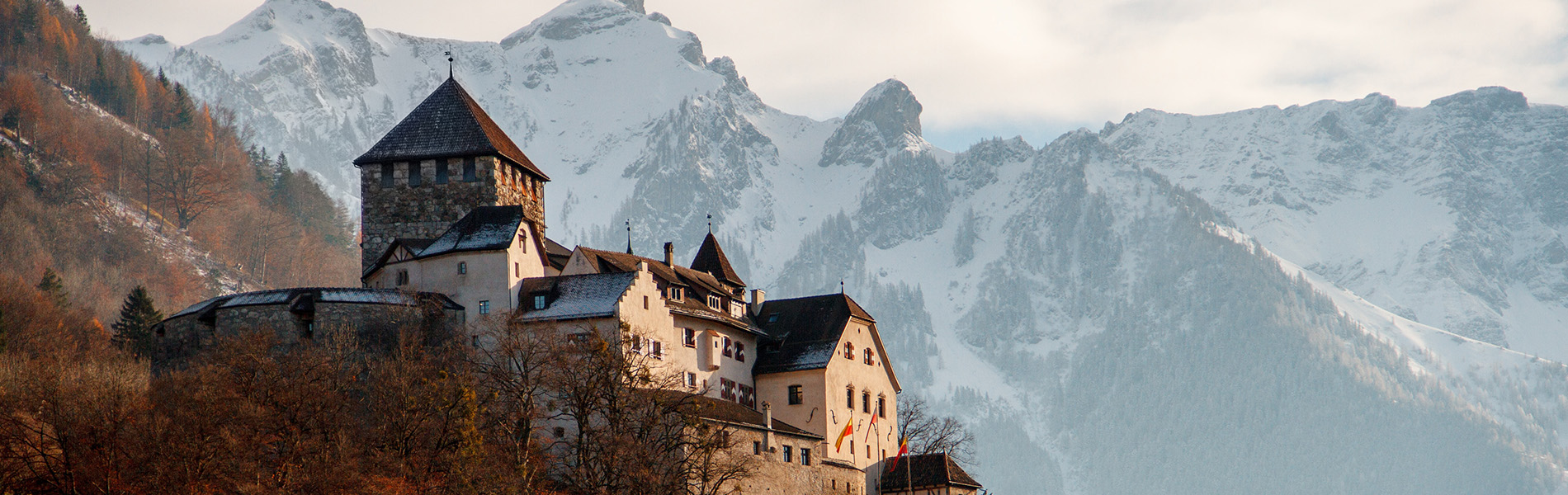
 Liechtenstein
Chapitres
Despite its small size and lack of natural resources, Liechtenstein has developed into a prosperous, highly industrialised, free-enterprise economy with a vital financial services sector and one of the highest per capita income levels in the world. The Liechtenstein economy is widely diversified with a large number of small and medium-sized businesses, particularly in the services sector. Low business taxes – a flat tax of 12.5% on income is applied – and easy incorporation rules have induced many holding companies to establish nominal offices in Liechtenstein. The Principality of Liechtenstein is also recognised as an important financial centre, primarily due to its specialisation in financial services for foreign entities.
Source: Economy

Indicateurs clés
- Surface
- 160 sq km
- Population
- 40,450 (2024)
- Type de gouvernement
- constitutional monarchy
- Langues
- German 91.5% (official) (Alemannic is the main dialect), Italian 1.5%, Turkish 1.3%, Portuguese 1.1%, other 4.6% (2015 est.)
- PIB
- $8.24 billion (2023)
- Taux de croissance
- 1.5% (2024)
- HDI
- 17
- Capitale
- Vaduz
Indicateurs macroéconomiques
Compared to the real GDP in 1972, Liechtenstein’s economic output has nearly quintupled by 2023. Between 2012 and 2018, the Liechtenstein economy recovered from the financial crisis, the subsequent low international demand, the reforms in the financial sector, and the various appreciation shocks of the Swiss franc. In terms of level, in 2016, the price-adjusted GDP for the first time exceeded that of 2007. In 2020, Liechtenstein’s economy was also hit by the COVID-19 pandemic and real GDP fell by about −5%, but the decrease was not as severe as in the financial crisis of 2008/09. Similar to the global economy, Liechtenstein recovered strongly from the COVID-19 shock and pronounced catch-up effects were noticeable in 2021, especially in the case of investment goods exports. The latest estimate by the Liechtenstein Institute suggests a real GDP growth rate of 0% for 2023. From the turn of the millennium on, the gross domestic product (domestic value added) and the gross national income (income of residents) have diverged in Liechtenstein. The trend in price-adjusted GNI nearly stagnated, but high increases in 2016 and 2017 (+19% and +12%) made sure that the 2007 level was exceeded again, so that in 2017, GNI exceeded GDP for the first time since 2000. In 2018, real GNI per capita reached its highest level since national accounts began in 1998. Normally, GNI in Liechtenstein tends to be lower than GDP, since the high proportion of commuters in the total employment means that a large part of the domestically generated labour income flows abroad and thus exceeds the usually achieved surplus of cross-border net capital income. However, with the strong average increases in GNI in recent years, the gap between GDP and GNI has closed again.
Le Luxembourg et le pays
Existing conventions and agreements
Non double taxation agreement
In order to promote international economic and financial relations in the interest of the Grand Duchy of Luxembourg, the Luxembourg government negotiates bilateral agreements for the avoidance of double taxation and prevent fiscal evasion with respect to Taxes on Income and on fortune with third countries.
- Convention from 16.08.2009 (Memorial 2010, A No.51, p.878)
- Effective as of 01.01.2011 (Memorial 2010, A No.51, p.878)
Air Services agreement
None
Informations supplémentaires
Foreign Trade
The Statec Foreign Trade statistics provide information on the trade of goods - by product and by country. This information is collected respectively through the INTRASTAT declaration and on the basis of customs documents.
You can see the statistics on the website of the Statec.
Contact points in Liechtenstein
Embassy of the Grand Duchy of Luxembourg in Berne
Ambassador with residence in Berne: Mr Robert LAUER
38 Sulgenauweg
CH-3007 Berne
Tél.: ( 41 -31) 311 47 32
(+41 -31) 311 68 76
E-Mail: berne.amb@mae.etat.lu
Website: berne.mae.lu
Honorary Consul
Vaduz
Honorary Consul General with jurisdiction over the Principality of Liechtenstein
Mr Marcel MÜLLER
Landstrasse 104
Postfach 559
9490 Vaduz
Liechtenstein
Tel. +423 239 32 55
E-Mail: vaduz@consul-hon.lu
Source: Ministry of Foreign Affairs of Luxembourg
Country risk as defined by Office du Ducroire for Liechtenstein
Ducroire is the only credit insurer covering open account deals in over 200 countries. A rating on a scale from 1 to 7 shows the intensity of the political risk. Category 1 comprises countries with the lowest political risk and category 7 countries with the highest. Macroeconomics experts also assess the repayment climate for all buyers in a country.
Link: ODL - Liechtenstein