



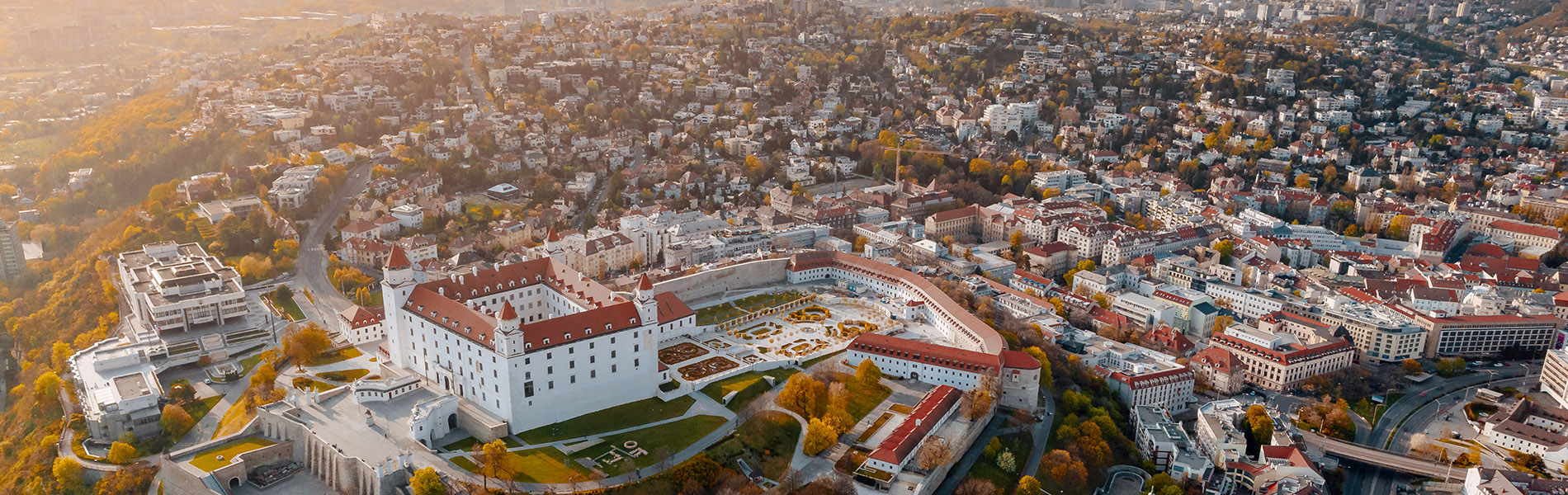
 Slovakia
Kapitel
Slovakia’s economy relies heavily on industry and exports, especially in automotive and electronics, with strong links to neighbouring EU markets such as Germany, the Czech Republic and Poland. Growth has been moderate, supported by private consumption and public investment, including funding from EU programmes, but remains vulnerable to external demand and trade tensions. The country faces ongoing challenges such as labour shortages, regional disparities, and high unemployment in some areas, as well as limited research and development in its export sectors. Public finances have shown budget and current account deficits, and inflation and fiscal consolidation efforts are influencing economic performance. Continued EU funding and domestic demand are expected to support gradual growth, while uncertainties in global trade and structural weaknesses will continue to shape the outlook.
Source: Coface

Kennzahlen
- Fläche
- 49,035 sq km
- Bevölkerung
- 5,422,069 (2024)
- Regierungsform
- parliamentary republic
- Sprachen
- Slovak (official) 81.8%, Hungarian 8.5%, Roma 1.8%, other 2.2%, unspecified 5.7% (2021 est.)
- BIP
- $140.93 billion (2024)
- Wachstumsrate
- 1.9% (2024)
- HDI
- 44
- Hauptstadt
- Bratislava
Makroökonomische Indikatoren
Real GDP growth is expected to slow to 0.8% in 2025, supported by private consumption and investment. Following the strong trade activity in the beginning of the year, likely boosted by the frontloading ahead of the higher US tariffs, exports are expected to contract in the second half of 2025 due to the tariff implementation effects. Net exports are projected to contribute negatively to growth in 2025. Slovakia’s exposure to direct and indirect effects of tariffs remains high due to its strong reliance on exports, with its industrial sector underperforming in recent months. Private consumption growth is set to decelerate compared to 2024, affected by the VAT tax increase in early 2025 and high economic uncertainty.
For 2026, real GDP growth is projected at 1.0%, before increasing to 1.4% in 2027. In 2026, growth in private consumption is forecast to continue slowing due to fiscal consolidation. Public investment is forecast to remain strong amid economic uncertainties, supported by the deployment of EU funds and defence equipment purchases. Trade activity is expected to slow in 2026 under the impact of higher tariffs and subdued global demand, with Slovakia being exposed to the US market due to its sizeable automotive industry. As foreign demand picks up only slowly, export growth is expected to rebound in 2027, supported by the launch of a new automotive production factory. Private consumption growth is set to increase in 2027, although potential further consolidation efforts pose a downside risk to growth. A weaker economic performance of the country’s major trading partners poses another downside risk throughout the forecast horizon.
IMF Statistics:
| Subject descriptor | 2022 | 2023 | 2024 | 2025 | 2026 |
|---|---|---|---|---|---|
|
All Items, Consumer price index (CPI), Period average, percent change Percent (Units) |
12.132 |
10.963 |
3.149 |
4.240 |
4.159 |
|
Current account balance (credit less debit), Percent of GDP Percent (Units) |
-9.630 |
-3.024 |
-4.624 |
-3.621 |
-3.012 |
|
Current account balance (credit less debit), US dollar US dollar (Billions) |
-11.159 |
-4.041 |
-6.515 |
-5.593 |
-5.087 |
|
Exports of goods and services, Volume, Free on board (FOB), Percent change Percent (Units) |
2.918 |
-0.244 |
-0.348 |
4.130 |
2.924 |
|
Gross domestic product (GDP), Constant prices, Percent change Percent (Units) |
0.545 |
2.113 |
1.939 |
0.807 |
0.601 |
|
Gross domestic product (GDP), Current prices, Per capita, US dollar US dollar (Units) |
21322.934 |
24612.667 |
25972.304 |
28497.802 |
31241.763 |
|
Gross domestic product (GDP), Current prices, US dollar US dollar (Billions) |
115.884 |
133.617 |
140.892 |
154.442 |
168.897 |
|
Imports of goods and services, Volume, Cost insurance freight (CIF), Percent change Percent (Units) |
4.357 |
-7.082 |
2.023 |
3.919 |
2.103 |
|
Unemployment rate |
6.150 |
5.842 |
5.333 |
5.408 |
5.760 |
Estimates
Source: IMF Statistics - Slovakia
Luxemburg und das Land
Existing conventions and agreements
Non double taxation agreement
In order to promote international economic and financial relations in the interest of the Grand Duchy of Luxembourg, the Luxembourg government negotiates bilateral agreements for the avoidance of double taxation and prevent fiscal evasion with respect to Taxes on Income and on fortune with third countries.
- Convention from 18.03.1991 (Memorial 1992, A No.106, p.3142)
- Effective as of 01.01.1993 (Memorial 1992, A No.106, p.3142)
Air Services agreement
- Agreement from 06.12.1968 (Memorial 1971, A, p. 2170)
- Effective as of 03.17.1972 (Memorial 1972, A, p. 806)
Weitere Informationen
Foreign Trade
The Statec Foreign Trade statistics provide information on the trade of goods - by product and by country. This information is collected respectively through the INTRASTAT declaration and on the basis of customs documents.
You can see the statistics on the website of the Statec.
Contact points in Slovakia
Embassy of the Grand Duchy of Luxembourg in Vienna
Ambassador with residence in Vienna: Mr Jean GRAFF
Sternwartestrasse 81
A - 1180 Wien
Tel.: (+43) (0)1 478 21 42
Fax: (+43) (0)1 478 21 44
E-Mail: vienne.amb@mae.etat.lu
Website: vienne.mae.lu
Honorary Consul
Bratislava
Honorary Consul with jurisdiction in the Slovak Republic:
Mr Peter KRISKO
Prievozska 4/A
SK-821 09 Bratislava
Slovakia
Tel.: (+421) 26542 9961
E-mail: bratislava@consul-hon.lu
Source: Ministry of Foreign Affairs of Luxembourg
Country risk as defined by Office du Ducroire for Slovakia
Ducroire is the only credit insurer covering open account deals in over 200 countries. A rating on a scale from 1 to 7 shows the intensity of the political risk. Category 1 comprises countries with the lowest political risk and category 7 countries with the highest. Macroeconomics experts also assess the repayment climate for all buyers in a country.
Link: Ducroire Office – Country Risk for Slovakia