

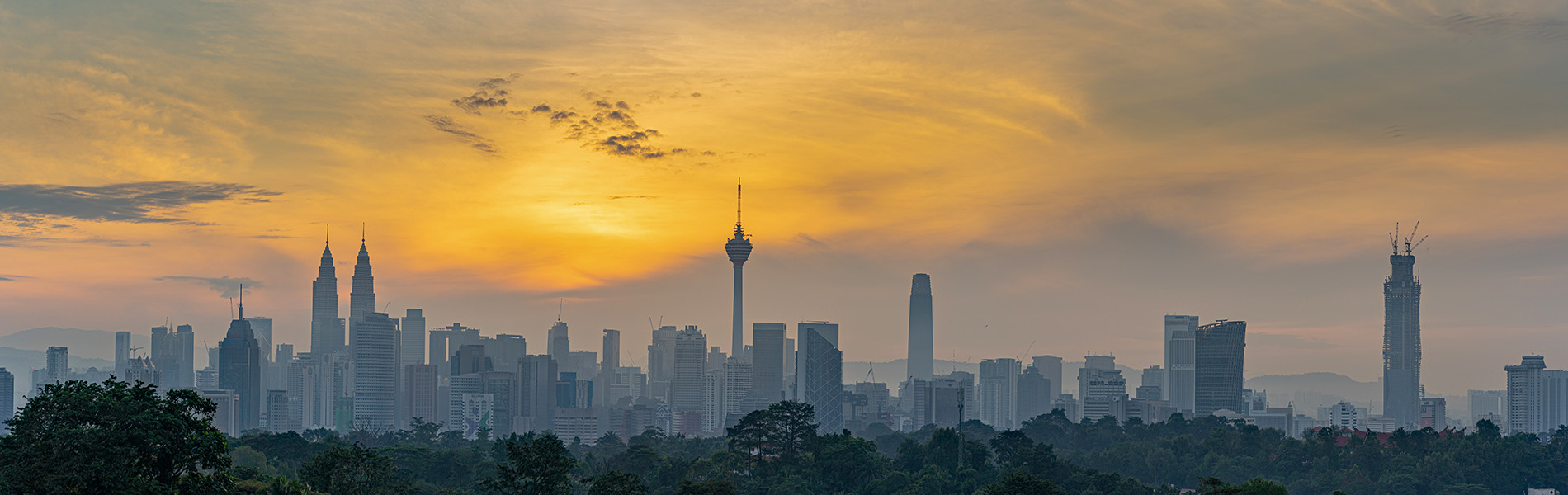
 Malaysia
Kapitel
Since gaining independence in 1957, Malaysia has undergone a profound economic transformation—from a predominantly agriculture- and commodity-based economy to one anchored in robust manufacturing and services. Today, the country is deeply integrated into global value chains in electronics, machinery, chemicals, and palm-based products. At home, a growing middle class has powered resilient private consumption, supporting expansion in retail, housing, education, healthcare, and modern services. This transformation has reduced extreme poverty and broadened opportunities. Looking ahead, Malaysia aims to achieve high-income status by deepening skills, fostering innovation, and advancing sustainability so growth remains inclusive and resilient.
Source: World Bank

Kennzahlen
- Fläche
- 35,977,838 (2025)
- Bevölkerung
- 33,519,406 (July 2021 est.)
- Regierungsform
- federal parliamentary constitutional monarchy
- Sprachen
- Bahasa Malaysia (official), English, Chinese (Cantonese, Mandarin, Hokkien, Hakka, Hainan, Foochow), Tamil, Telugu, Malayalam, Panjabi, Thai
- BIP
- $470.5 billion
- Wachstumsrate
- 4.5% (2025)
- HDI
- 62
- Hauptstadt
- Kuala Lumpur
Makroökonomische Indikatoren
Malaysia is more open to trade than nearly 90 percent of countries in the world, surpassing many of its regional peers. Its openness to trade and investment has driven employment creation and income growth, with approximately 40 percent of jobs linked to export activities.
These achievements can be attributed to strategic development policies focusing on outward-oriented, labor-intensive growth; investments in human capital; and credible economic governance to ensure macroeconomic stability.
As Malaysia advances toward its high-income transition, it is presented with new opportunities for growth and reform. While economic expansion has moderated, the country has a strong foundation to build on. By further boosting high-skilled employment, accelerating wage and productivity growth, strengthening tax collection and social protection, enhancing environmental stewardship, and deepening efforts against corruption, Malaysia can unlock its full potential and ensure that prosperity is both sustainable and inclusive.
Source: World Bank
IMF Statistics:
| Subject descriptor | 2022 | 2023 | 2024 | 2025 | 2026 |
|---|---|---|---|---|---|
|
All Items, Consumer price index (CPI), Period average, percent change Percent (Units) |
3.379 |
2.489 |
1.834 |
1.381 |
1.894 |
|
Current account balance (credit less debit), Percent of GDP Percent (Units) |
3.188 |
1.099 |
1.434 |
1.573 |
1.393 |
|
Current account balance (credit less debit), US dollar US dollar (Billions) |
13.002 |
4.396 |
6.056 |
7.429 |
7.196 |
|
Exports of goods and services, Volume, Free on board (FOB), Percent change Percent (Units) |
9.371 |
-4.586 |
-0.705 |
1.906 |
2.003 |
|
Gross domestic product (GDP), Constant prices, Percent change Percent (Units) |
9.032 |
3.537 |
5.105 |
5.171 |
4.700 |
|
Gross domestic product (GDP), Current prices, Per capita, US dollar US dollar (Units) |
12490.212 |
12097.990 |
12618.720 |
13948.737 |
15085.379 |
|
Gross domestic product (GDP), Current prices, US dollar US dollar (Billions) |
407.830 |
399.949 |
422.227 |
472.193 |
516.428 |
|
Imports of goods and services, Volume, Cost insurance freight (CIF), Percent change Percent (Units) |
16.844 |
-4.525 |
8.671 |
6.270 |
2.507 |
|
Unemployment rate |
3.825 |
3.425 |
3.225 |
3.000 |
3.000 |
Estimates
Source: IMF Statistics - Malaysia
Luxemburg und das Land
Existing conventions and agreements
Non double taxation agreement
In order to promote international economic and financial relations in the interest of the Grand Duchy of Luxembourg, the Luxembourg government negotiates bilateral agreements for the avoidance of double taxation and prevent fiscal evasion with respect to Taxes on Income and on fortune with third countries.
- Convention from 21.11.2002 (Memorial 2004, A No.80, p.1148)
- Effective as of 01.01.2005 (Memorial 2004, A No.80, p.1148)
Air Services agreement
- Agreement from 01.19.1979 (Memorial 1980, A, p. 475)
- Effective as of 05.14.1980
- New Agreement from 21.11.2002
Weitere Informationen
Contact points in Malaysia
Embassy of the Grand Duchy of Luxembourg in Malaysia
Ambassador with residence in Bangkok: H.E. Mr. Patrick HEMMER
Q House Lumpini 17th Floor
1 South Sathorn Road
Tungmahamek Sathorn
Bangkok 10120
Thailand
Tel.: (+66 2) 677 7360
Fax: (+66 2) 677 7364
E-Mail: bangkok.amb@mae.etat.lu
Website: bangkok.mae.lu
Honorary Consul
Honorary Consul with jurisdiction in Malaysia:
Ms Nor Rejina Abdul Rahim
c/o Nomura Asset Management Malaysia Sdn.Bhd
Suite 12.2, 12th Floor, Menara IMC
8 Jalan Sultan Ismail
50250 Kuala Lumpur
Malaysia
Tel.: (+60)3-2027 6615
Fax: (+60)3 2027 6624
E-Mail: kualalumpur@consul-hon.lu
Source: Ministry of Foreign Affairs of Luxembourg