



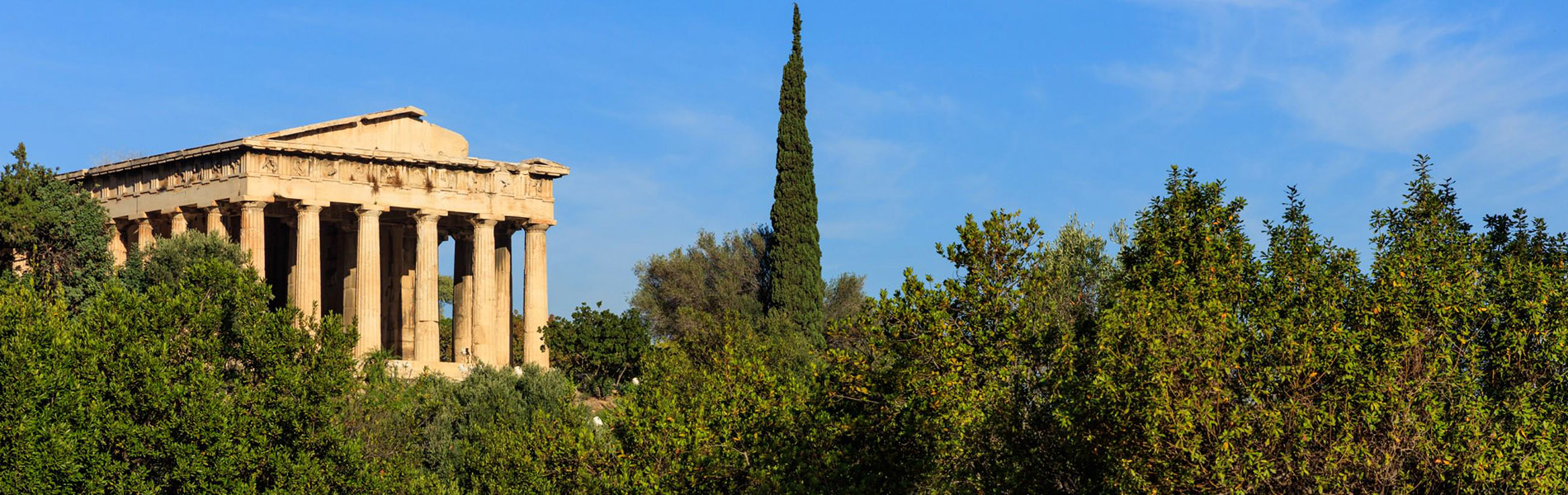
 Greece
Kapitel
Greece’s economy has demonstrated steady growth and resilience, recovering from previous fiscal strains and structural adjustments. Forecasts point to sustained GDP growth over the next few years, supported by robust domestic demand, rising investment, and a recovering labour market. The Recovery and Resilience Facility (the NextGenerationEU’s main instrument), which is allocating EUR 36 billion to Greece, divided equally between grants and loans, will ensure sustained demand for sectors such as infrastructure construction, telecommunications and renewable energy, while generating positive externalities that strengthen potential output.
Strengths include Greece’s world-leading position in maritime transport, a booming tourism sector, a rapidly improving business climate, and consolidating bank balance sheets. At the same time, Greece continues to build on its economy while managing challenges such as high public debt and reliance on key sectors, and pursuing opportunities to diversify its industrial base and energy sources.
Source: Coface

Kennzahlen
- Fläche
- 131,957 km2
- Bevölkerung
- 10,405,134 (2024)
- Regierungsform
- parliamentary republic
- Sprachen
- Greek (official) 99%, other (includes English and French) 1%
- BIP
- $256.24 billion (2024)
- Wachstumsrate
- 2.1% (2024)
- HDI
- 34
- Hauptstadt
- Athens
Makroökonomische Indikatoren
In the first half of 2025, Greece's economy grew by 2% y-o-y, largely driven by private consumption and tourism. Investments picked up in the second quarter, especially construction and equipment investments.
Overall, the economy is expected to sustain its growth momentum in the second half of 2025 and throughout 2026. Investment activity is expected to remain robust in 2025 and 2026, supported by the double-digit growth in corporate lending and the implementation of the RRP. Additionally, a new package of expansionary fiscal measures is expected to boost net wage growth and private consumption. Import demand is set to remain strong, given the high import content of investments. Although no sharp cliff effect is expected, growth is forecast to slow after 2026 as the RRP implementation comes to an end. GDP growth is projected to be relatively stable, with rates of 2.1% in 2025 and 2.2% in 2026, before moderating to 1.7% in 2027. While the economy has so far demonstrated resilience to external challenges, a prolonged increase in geopolitical or trade uncertainty and financing costs could significantly weigh on exports, particularly in the tourism sector, and on investment activity.
The unemployment rate declined to 8.2% in October 2025, its lowest level since 2009, but remains above the EU average. After peaking in the second quarter of 2024, vacancy rates have eased slightly, although they still suggest a relatively tight labour market, particularly in the tourism and construction sectors. Employment is expected to continue growing, albeit at a slower pace due to structural issues, such as skill gaps and low participation rates, especially among women. Wages per employee are set to accelerate, with an average annual growth rate of 3.6% over the forecast period, driven in part by past hikes in minimum wages, a decrease in social security contributions and the recently announced personal income tax reform.
After averaging 3.1% in the first half of 2025, headline inflation declined to 1.7% by October, driven by a decrease in the energy and services inflation. However, robust demand and a still-tight labour market are expected to maintain upward pressure on consumer prices. As a result, inflation is forecast to decline only slowly, reaching 2.8% in 2025 and 2.3% in 2026. While headline inflation excluding energy and food is anticipated to ease, the projected increase in energy prices is expected to keep inflation at 2.4% in 2027.
Source: European Commission
IMF Statistics:
| Subject descriptor | 2022 | 2023 | 2024 | 2025 | 2026 |
|---|---|---|---|---|---|
|
All Items, Consumer price index (CPI), Period average, percent change Percent (Units) |
9.297 |
4.156 |
2.997 |
2.889 |
3.467 |
|
Current account balance (credit less debit), Percent of GDP Percent (Units) |
-10.747 |
-6.801 |
-7.157 |
-5.683 |
-6.394 |
|
Current account balance (credit less debit), US dollar US dollar (Billions) |
-23.446 |
-16.528 |
-18.334 |
-15.938 |
-19.665 |
|
Exports of goods and services, Volume, Free on board (FOB), Percent change Percent (Units) |
7.524 |
2.722 |
0.895 |
1.836 |
0.955 |
|
Gross domestic product (GDP), Constant prices, Percent change Percent (Units) |
5.522 |
2.136 |
2.087 |
2.073 |
1.802 |
|
Gross domestic product (GDP), Current prices, Per capita, US dollar US dollar (Units) |
20853.518 |
23335.570 |
24688.425 |
27040.815 |
29695.960 |
|
Gross domestic product (GDP), Current prices, US dollar US dollar (Billions) |
218.162 |
243.016 |
256.161 |
280.476 |
307.554 |
|
Imports of goods and services, Volume, Cost insurance freight (CIF), Percent change Percent (Units) |
3.433 |
0.771 |
2.362 |
5.778 |
1.625 |
|
Unemployment rate |
12.425 |
11.075 |
10.100 |
8.917 |
7.428 |
Estimates
Source: IMF Statistics - Greece
Luxemburg und das Land
Existing conventions and agreements
Non double taxation agreement
In order to promote international economic and financial relations in the interest of the Grand Duchy of Luxembourg, the Luxembourg government negotiates bilateral agreements for the avoidance of double taxation and prevent fiscal evasion with respect to Taxes on Income and on fortune with third countries.
- Convention from 22.11.1991 (Memorial 1992, A No.96, p.2643)
- Effective as of 01.01.1996 (Memorial 1992, A No.96, p.2643)
Air Services agreement
- Agreement from 10.22.1951 (Memorial 1953, p. 249 )
- Effective as of 10.08.1953 (Memorial 1953, p. 1079)
Weitere Informationen
Contact points in Greece
Embassy of the Grand Duchy of Luxembourg in Greece
Ambassador with residence in Athens: Mr Paul SCHMIT
23A, avenue Vassilissis Sofias 2,
Street Neofytou Vamva
GR - 10674 Athens
Greece
Tel.: +30 210 725 64 00
Fax: +30 210 725 64 05
E-Mail: athenes.amb@mae.etat.lu
Site web: www.athenes.mae.lu
Honorary consuls
Honorary Consul with jurisdiction over the Region of Attica:
Ms Artémis PAPATHEODOROU
42C Tzavella
154 51 Néo Psychico
Athens
Greece
Tel.: (+30) 210 672 18 91
Fax: (+30) 210 677 34 44
E-Mail: athenes@consul-hon.lu
Honorary Consul with jurisdiction over the Department of Macedonia:
Mr Yannis VERGINIS
47, rue Stélios Kazantzidis
Pylaia – Ktiro thermi 1
BP. 8101 - 57001 Thessalonique
Greece
Tel.: (+30) 2310 999994
Mobile: (+30) 6944 324 546
Fax: (+30) 2310 999997
E-Mail: thessalonique@consul-hon.lu
Honorary Consul with jurisdiction over Crete:
Mr Georgios AERAKIS
2-4, rue Thessalonikis - 2ème étage
71 201 Héraklion - Crete
Greece
Tel.: (+30) 2810 224 001; (+30) 2810 282 625
Mobile: (+30) 6976 418 091
E-Mail : heraklion@consul-hon.lu
Source: Ministry of Foreign Affairs Luxembourg
Country risk as defined by Office du Ducroire for Greece
Ducroire is the only credit insurer covering open account deals in over 200 countries. A rating on a scale from 1 to 7 shows the intensity of the political risk. Category 1 comprises countries with the lowest political risk and category 7 countries with the highest. Macroeconomics experts also assess the repayment climate for all buyers in a country.
Link: Ducroire Office – Country Risk for Greece